feega
available on macOS Windows Linux

your Codex repo, with a visual editor. no Framer project to keep in step.

Framer lists Codex as an external agent for a Framer project, which keeps the page in Framer. Feega keeps it in your repo: Codex edits the files locally, and you adjust the page visually on top of them.

support with a coffee

  • free, forever
  • every edit a diff
  • no AI, no tokens
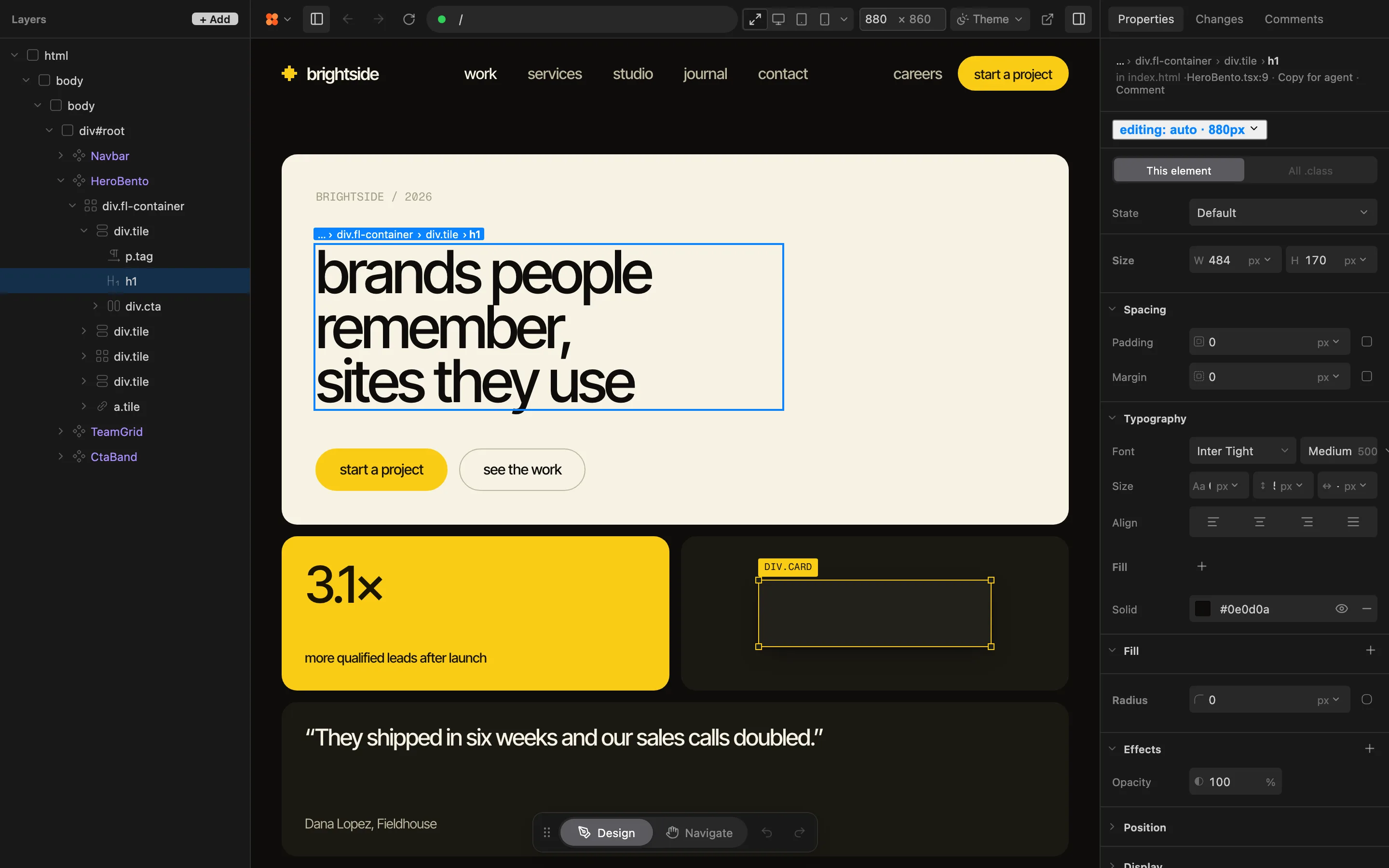
The Feega editor on a React project: the Layers tree, a creative agency page with its heading selected, and the Properties bar showing HeroBento.tsx under the selection

works with

or any Vite app

Framer and Feega with Codex, side by side

aspectFramerFeega with Codex
where the code livesIn a Framer projectIn your local repo, next to Codex
costFree $0, Basic $10, Pro $30 a month (checked 22 November 2026)Free, open source under Apache-2.0, no account. Codex runs on a ChatGPT plan or an API key
export and gitCode export not described on the pages we readYour own git, with checkpoints advised by Codex. You commit
agent accessCodex through MCP or a local CLI setup, editing FramerCodex edits your files, and Feega shows the selected element’s source
where it runsCloud editor and hostingLocal. Pair it with Codex CLI, the IDE extension or the desktop app

Keep Framer for sites designers own and publish, where a CMS, staging and hosting on one page matter.

checked 22 November 2026 read the full comparison →

why Codex users pick Feega over Framer

  1. 01

    Codex on a repo, not on a project

    Framer describes Codex as an agent that updates a Framer project through MCP or a local CLI setup, and Framer then publishes. On a repo, Codex inspects local files, edits them and runs the tools you already have. The page can use your components and your tests.

  2. 02

    what a terminal agent lacks

    Codex sees files, not the rendered page. Feega shows the running page and marks the source line of the element you select. You set the spacing and type by eye, and Codex reads the new values on its next pass.

  3. 03

    A migration in four moves

    List what the Framer page contains, ask Codex to rebuild one section in your repo, open it in Feega to adjust spacing and type, then repeat per section and switch the domain when the repo version matches. Plan to rebuild rather than convert.

click any element of your running app, design it like in Figma, and the change lands in your code. in VS Code, Cursor and Windsurf. free, no AI, with diffs.

VS Code · Cursor · Windsurf

design in your codebase

click any element of your running app and edit it like in Figma. the change is written to your code. no AI, no tokens, every edit a diff. free.

  1. run your app

    open it in your editor as usual.

  2. click and edit

    spacing, colour, type. like in Figma.

  3. review the diff

    written to your code, Tailwind or plain CSS.

questions from this switch

does Feega read my Framer project?

no. Feega works on code that runs in your own dev server. A Framer site would first have to be rebuilt in your repo, section by section.

can i keep both while i move?

yes, and you should. keep the Framer site live until the repo page matches it, then switch the domain. Framer describes a reverse proxy for putting a Framer site behind your own host, which can help during the move.

what does Codex do versus Feega?

Codex runs commands and edits files from a terminal, an IDE extension or a desktop app. Feega sets values you can see: spacing, colour, radius and type. use Codex for routes and forms, Feega for the finish.

do i need AI in Feega?

no. Feega has no model and no tokens, and each edit is a diff you can undo. the AI cost on this path is only Codex’s own plan or API key.

is Feega free?

yes. the extension and npx feega are free and open source under Apache-2.0. Feega Cloud, with GitHub sync, collaboration, sections and templates, is coming soon.

the Feega extension is free

  • €0, forever
  • every edit a diff
  • no AI, no tokens
free sections and UI templates for Svelte, React, Vue and Astro →

the extension is free. Feega Cloud is coming soon.

Feega extension

click an element of your running app, edit it, ship the diff.

free forever

download for free

no account, no card, no AI.

  • VS Code, Cursor, Windsurf and VSCodium
  • React, Next.js, SvelteKit, Vue, Nuxt, React Router, Astro and Vite
  • Tailwind or plain CSS
  • every change written to your code, with a diff
  • open source, Apache-2.0

Feega Cloud

for teams that design in the same codebase.

€15 / editor / month

follow on github

or €12 a month billed annually, €144 a year. viewers are free. coming soon. star the repo to hear first.

  • GitHub sync
  • collaboration
  • sections and templates
  • all pro templates

the free library is already open: free templates

questions

what is Feega?

A free tool that runs as a VS Code extension, or in your browser with npx feega. click any element of your running app, edit it like in Figma, and the change is written to your code. no AI, no tokens, every edit shown as a diff. the code is on GitHub.

can i use Feega for free?

yes. the Feega extension is free, with no account and no AI. Feega Cloud, with GitHub sync, collaboration, sections and templates, is coming soon.

which editors and frameworks does it support?

VS Code, Cursor, Windsurf and VSCodium, or any terminal with npx feega. React, Next.js, SvelteKit, Vue, Nuxt, React Router, Astro and Vite, styled with Tailwind or plain CSS.

does it need an AI agent?

no. Feega works without agents. there are no models and no tokens. your edits are written to your code deterministically, and you review every change as a diff.

what is Feega Cloud?

coming soon: GitHub sync, collaboration, sections and templates. the extension stays free.

who owns my work, and is it used to train AI?

you keep your content; we never train AI on it. details are in our terms and privacy policy.

see full pricing →

start designing in your code

support with a coffee

  • free, forever
  • every edit a diff
  • no AI, no tokens