The open-source, local Framer alternative for OpenAI Codex users
By Andrea Buttarelli, founder of Feega · checked 2026-11-22 · how we checked
Keep Framer if designers own the site. If Codex already writes your landing page in a repo, you can keep the page there. Feega edits the repo by hand, and Codex keeps working in the same files.
see it in action → The short version of this comparison, for Codex users.
Framer, OpenAI Codex and Feega at a glance
| Framer | Feega | |
|---|---|---|
| Where the page lives | In a Framer project, hosted by Framer | In your repo, hosted wherever you host |
| Source files | No code export or git sync on the pages we read | Your own files, edited in place |
| Your coding agent | OpenAI Codex works in your repo; the tool wants its own copy | Runs locally in a terminal, an IDE or a desktop app |
| Agents | External Agents connect through MCP or a local CLI setup | They read the files Feega writes |
| Price | Free at $0, Basic $10 a month, Pro $30 a month | Free, Apache-2.0 |
Framer, Codex and Feega side by side
| Framer | Codex in your repo | Feega | |
|---|---|---|---|
| Where the code lives | In a Framer project (Framer help: publishing and hosting) | In your local repo | In your local repo |
| Pricing model | Free $0, Basic $10, Pro $30 a month (Framer pricing, 22 November 2026) | A ChatGPT plan or an API key | Free, Apache-2.0 |
| Export and git | Not stated on the pages we read | Your git, with checkpoints advised | Writes files; you commit |
| Local or cloud | Cloud editor and hosting | CLI, IDE and desktop app are local; Codex Web is cloud (OpenAI Codex on GitHub) | Local |
| Agent access | Codex through MCP or a local CLI setup (Framer developers) | Edits files directly | Shows the source of the selected element |
| Fits | Sites designers own | Terminal work (OpenAI: Codex CLI) | Hand edits on a page in code |
Framer wants the page inside Framer
On the pricing and help pages we read, Framer publishes the site to its own hosting. None of those pages mentions exporting the site as code or syncing it with git, so the Framer project stays the source of truth for the page.
That works until the landing page belongs to your product. Tokens, copy and components that also live in your app have to be copied across by hand each time one of them changes.
- Design in Framer
- Publish to Framer hosting
- Copy tokens by hand
- Repeat for each change
- Open the repo
- Click the element
- Set the value
- Review the diff
A real edit, written to source
Here is what a hand edit leaves behind in app/page.tsx. Feega writes at the line of the element you clicked, as a Tailwind class or a rule in your own CSS, and nothing else in the file moves.
Codex reads files and Framer holds a project, so only one of them needs your repo. The diff is the same one your agent will read on its next turn, and the same one git will show in review.
  <section
-   className="py-16 text-center"
+   className="py-24 text-center"
  >
Codex works in a terminal, Feega works on the page
A terminal agent never sees your browser. Feega closes that gap without a model: you click the element on the running page, and Feega shows its source line in an editor beside it, so Codex, which the Feega docs list among the agents that read the editor selection, can see what you picked.
For a plain terminal session, use Copy for agent and paste the file, line, selector and preview width into the prompt. Codex then edits the same line Feega writes to.
when to choose which
choose Framer if
- Designers publish the site themselves.
- You want hosting and a CMS in one place.
- The page shares no code with your app.
choose Feega if
- Codex already writes your landing page in a repo.
- You prefer to set spacing by eye instead of in a prompt.
- You want no hosting plan or AI credits to pay for.
what each one costs
Framer’s free plan is $0 with 500 AI credits a month and a Framer domain. A custom domain needs Basic at $10 a month, and Pro is $30 a month, per its pricing page on 22 November 2026. Agents and other AI features spend credits.
Feega is free and open source under Apache-2.0, with no credits and no account. Hosting and your agent’s plan stay what they are today.
set up Codex once
OpenAI describes Codex CLI as a coding agent that runs locally on your computer. Its repository lists the terminal CLI, an IDE extension, a desktop app and Codex Web at chatgpt.com/codex. Feega edits files on your machine and needs your dev server running, so pair it with a local surface: the CLI, the IDE extension or the desktop app.
Feega’s docs name Codex among the agents the skill is meant for. Install it with npx skills add andreabuttarelli/feega in the project. The skill teaches the agent to add feega-source-map to a Next.js or Vite config, to start the editor and to write markup Feega can edit back.
moving a Framer page and its content into a repo
Framer’s CMS help lists a Markdown route: import, export and manage Markdown content. For a blog or a list of features, that is a clean way to carry the words into your repo as files that Codex can read and place.
The layout has no documented export, so rebuild it. Ask Codex to build each section from the live page, then open the running result in Feega and adjust spacing and type against Framer side by side. Keep the Framer site published until the repo version matches.
Framer also lists Codex as an external agent for a Framer project. That keeps the page in Framer, so choose it only if you want the page to stay there.
what to ask Codex, and what to do by hand
Give Codex the jobs that suit a terminal: add a route, wire a form, rename a prop across the project, fix a failing build. Ask it to keep class names literal and copy in the markup, so the result stays editable.
Keep the visual passes for Feega. Moving a card by a few pixels or choosing a colour by eye takes seconds on the page and a full prompt in the terminal. Between rounds, run git diff so Codex starts from what is on disk, not from its memory of the last turn.
where Framer is still the better choice
Framer is built for people who design in a canvas and publish without a developer. Its paid plans add a CMS, staging, branching with previews and redirects, so designers can ship on their own.
Feega has no CMS, no publishing and no hosting. If the people changing the page never open a repo, Framer fits them better.
more on Framer and your agent
This page covers OpenAI Codex. The wider comparison is on Framer alternatives. Other agents with the same question:
Feega is free. Download it or read the agents page in the docs.
Codex on a Framer project versus Codex on a repo
Framer developers says External Agents let you connect Claude Code, Codex or Cursor to update a Framer project. Framer help: AI and agents adds that this works through Framer MCP or a local CLI setup. Codex then changes Framer, and Framer publishes.
On a repo, OpenAI: Codex CLI describes the plain version: Codex inspects the local repository, edits files and runs tools already installed on your machine. The page can use your components, your tokens and your tests. The Framer overview sets this beside the other agents.
A migration in four moves
First, list what the Framer page contains: sections, fonts, colors, forms, CMS content. Second, ask Codex to rebuild one section in your repo and run the app. Third, open it in Feega and set the spacing and type by eye, then read the diff in Changes. Fourth, repeat per section and switch the domain when the repo version matches.
We did not find a code export on the Framer help: publishing and hosting page or the pricing page, so plan to rebuild rather than convert. Your agent guide for this setup is in the Feega docs: use Feega with AI agents, and the quick start covers the first run.
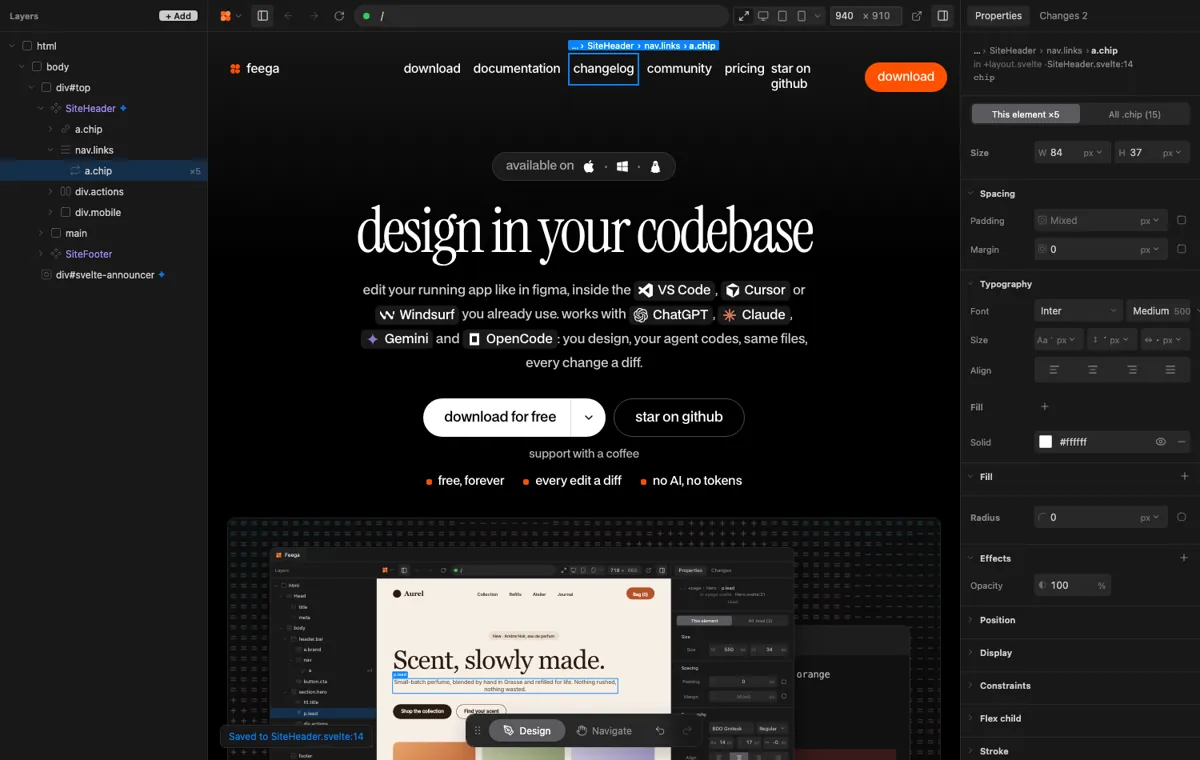
Try Feega in two minutes: run npx feega in your project folder, or install the extension.
Download Feega →costs to compare before the move
Per Framer pricing, Free is $0 with 500 AI credits a month, Basic is $10 with 1,000, and Pro is $30 with 3,000. Pro also lists branching and a staging environment. The page does not say whether those relate to git. Codex adds its own cost through a ChatGPT plan or an API key, and Feega adds none.
Moving a site means you take on hosting, so price that too. The Claude Code page runs the same numbers for a different agent. Feega itself is free, as the pricing page shows.
The agent guide lists every command and what each agent can see.
Read the agent docs →try Feega with OpenAI Codex in five steps
- Install the skillRun npx skills add andreabuttarelli/feega in the project folder.
- Ask for setupTell Codex to set the project up for Feega. It adds the source map where the framework needs it.
- Start the editorRun npx feega in a second terminal, or open the folder in the VS Code extension. Keep the dev server running.
- Click and setPick the element and change its values. Copy for agent puts the element’s location on your clipboard for the Codex prompt.
- Read the diffRun git diff or open Changes in Feega, then continue with Codex. Commit under your own name.
mistakes people make
Expecting an export button. The pages we read do not mention exporting the site as code. Ask Framer before you plan a migration.
Using Codex Web with a local editor. Feega edits files on your machine and needs your dev server. Use the CLI, the IDE extension or the desktop app.
Skipping the diff between turns. The agent should read the files you changed. Run git diff before the next prompt.
questions
Can Framer export my site as code?
The pricing and help pages we read do not say so.
How do I use Feega with Codex?
Install the skill with npx skills add andreabuttarelli/feega, run npx feega, and let Codex edit the same files.
Does Codex see what I select in Feega?
Feega reveals the selected element’s source beside it, and Codex is one of the agents that read the editor selection per the Feega docs.
Does Feega need an OpenAI account?
No. Feega has no account and no model.
Does Feega replace OpenAI Codex?
No. OpenAI Codex writes code and Feega sets visual values in the same files.
how we checked
We make Feega, so read our column with that in mind. We read each product's public pages on 2026-11-22 and compared what they offer, not finished work. Something wrong? Write to hi@feega.app.
- Framer pricing
- Framer developers
- Framer help: AI and agents
- OpenAI Codex on GitHub
- Feega docs: use Feega with AI agents
- Framer help: publishing and hosting
- OpenAI: Codex CLI
Feega is not affiliated with, endorsed by, sponsored by or connected to any company or product named on this page. All product names, logos and trademarks belong to their respective owners and are used only to identify those products. Information comes from their public pages on the date shown and may have changed since; check the source before you decide. This page is not legal, financial or purchasing advice.
Keep Framer for a site designers own. Keep Codex and the repo for a page your product shares.
download for free →